

Heat Pump Grants

new retrofit grants ireland march 2026
Heat Pump Grants

Higher Retrofit Grants to Boost Home Energy Upgrades

Homeowners could soon benefit from significantly increased financial support for energy upgrades under new retrofit measures expected to be announced by the Minister for Climate, Environment, Energy and Transport, Darragh O’Brien.

Under the proposed changes, attic insulation grants are set to rise to a fixed payment of €1,800, up from the current €1,500 cap for detached homes, with lower rates applying to other property types. This represents an increase of €300 for many households.

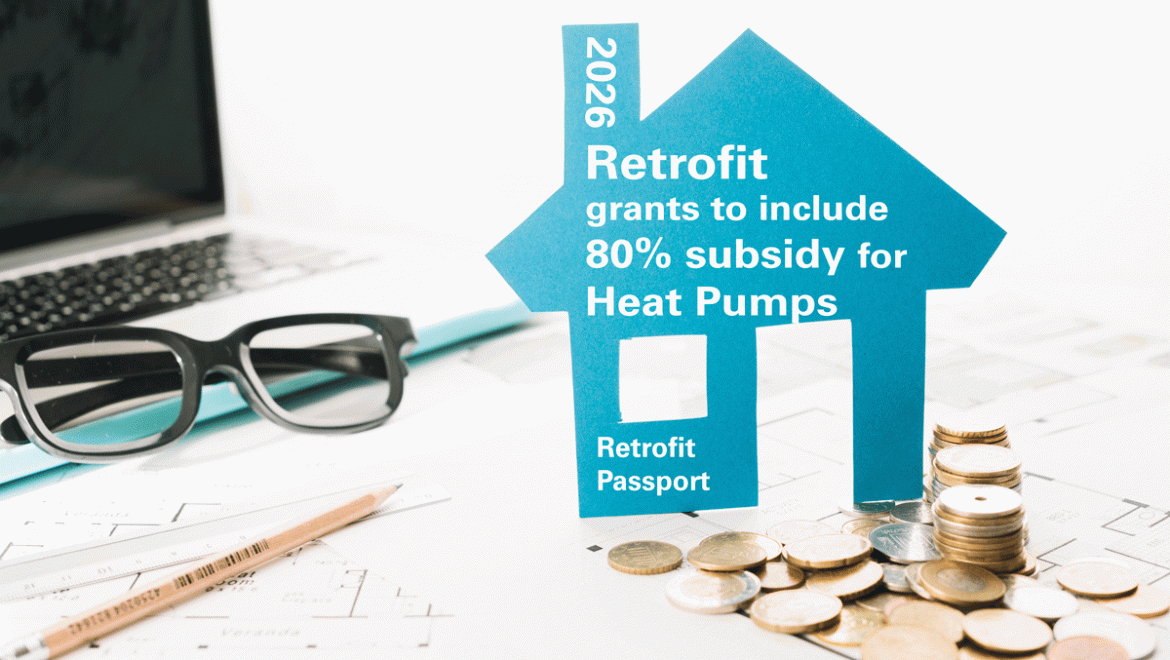
Heat pump grant supports are also expected to improve substantially. The maximum eligible cost will rise to €12,000, with the State covering up to 80% of the expense — equivalent to €9,600. At present, detached homeowners can claim a grant of €6,500. In some cases, the grant level will increase by €700 where a €12,000 upgrade is undertaken, bringing State support to €7,200. Fixed grant amounts for heat pumps will be introduced from March 3, with levels to be reviewed after two years.

For the first time, grants for windows and doors will be made available as standalone upgrades. Owners of semi-detached homes will be able to access grants of up to €3,000, with the State covering approximately 30% to 40% of costs. Previously, such works had to be carried out alongside other retrofit measures.

Overall, €558 million will be allocated to SEAI retrofit grants, highlighting the Government’s focus on tackling energy affordability. Electricity prices rose by an average of 4.7% last year, while around 300,000 households are currently in arrears on their energy bills, according to the Commission for Regulation of Utilities.

Approximately 240,000 homes have already been retrofitted nationwide. To build on this, the Minister is progressing plans for a “retrofit passport”, aimed at helping middle-income households upgrade their homes gradually rather than undertaking costly deep retrofits all at once.

The revised grant structure is intended to make supports more attractive and accessible. From March 3, fixed-amount attic insulation grants will also be available under the Better Energy Homes Scheme for first-time buyers of existing homes.

It is estimated that around 65,000 households will avail of energy upgrade grants this year. Mr O’Brien has said the aim is to permanently reduce household energy bills, particularly for those struggling with arrears, while also cutting emissions.

These measures come as Ireland faces challenges in meeting its 2030 climate targets. The national retrofit plan published in 2024 set a goal of upgrading 500,000 homes to a B2 BER rating and installing 400,000 heat pumps to replace fossil fuel systems by the end of the decade.

New government grants for heat pumps and home retrofits were announced on 27 January 2026 click here to find out more
r290 Heat Pumps
Heat Pump Grants

Important Update: Changes to Heat Pump Grant Application Process for Homes Built Before 2006

As of February 25, 2025, significant changes are being made to the application process for heat pump grants in Ireland. Homeowners of dwellings constructed before December 31, 2006, will no longer be required to undergo a Technical Assessment as part of their heat pump grant application, provided they meet certain conditions related to their Building Energy Rating (BER).

Key Changes for Homeowners:

  1. Valid BER Certificate & Advisory Report: If you are a homeowner of a property built before December 31, 2006, and you hold a valid BER Certificate and Advisory Report, you may now apply for a heat pump grant without the need for a technical assessment, as long as the Advisory Report states a compliant Heat Loss Indicator (HLI) of 2.3 W/m².k or below.
  2. Self-Declaration Form: To complete the application process, homeowners will be required to submit a self-declaration form. This form will confirm the following:
    • Year of Construction: The homeowner will confirm the year their property was built.
    • BER Certificate & Advisory Report: The homeowner will confirm they hold a valid BER Certificate and Advisory Report that states a compliant Heat Loss Indicator (HLI) of 2.3 W/m².k or below.
    • Opting Out of Technical Assessment: The homeowner must acknowledge that they are choosing to forgo the Technical Assessment.

How to Verify Your BER and Advisory Report:

Homeowners can easily verify their BER and Advisory Report by visiting the following link:
BER and Advisory Report Search

In order to access the report, you will need to provide your MPRN number (Meter Point Reference Number), which is a unique identifier for your property’s electricity connection.

Why Is This Change Being Implemented?

This new measure is designed to streamline the grant application process and make it easier for homeowners to access funding for heat pump installations, without the delays and costs associated with the Technical Assessment. The goal is to support more efficient heating solutions while reducing administrative burdens, especially for those whose homes already meet the required energy efficiency standards.

Important Notes:

  • Validity of BER Certificate: Ensure your BER Certificate and Advisory Report are up-to-date and contain the necessary information. If you don’t have these documents or need an updated report, it may be necessary to request a new BER assessment.
  • Self-Declaration Process: Carefully complete the self-declaration form as this will be part of the application process. Inaccurate information could delay or invalidate your application.

Conclusion:

These changes represent a major shift in how heat pump grants are processed for homes built before 2006, simplifying the process and making it easier for homeowners to make the transition to more sustainable heating solutions. Be sure to check your BER status, confirm your compliance with the HLI requirements, and submit your self-declaration form when applying for your heat pump grant.

For more information, visit the Sustainable Energy Authority of Ireland (SEAI) website or contact your local authority.